
I swam Tsugaru Strait on 19 June 2026. About 12½ hours in the water, and a landing that—if I’m honest—was harder than I’d hoped, but probably about what I expected. It was the final swim of my Oceans Seven. With it, I’ve become the first Irish woman to complete the set. That feels significant when I write it down. Mostly, though, it feels like relief. The quiet satisfaction of getting it done-something that started a very long time ago.
Where it started
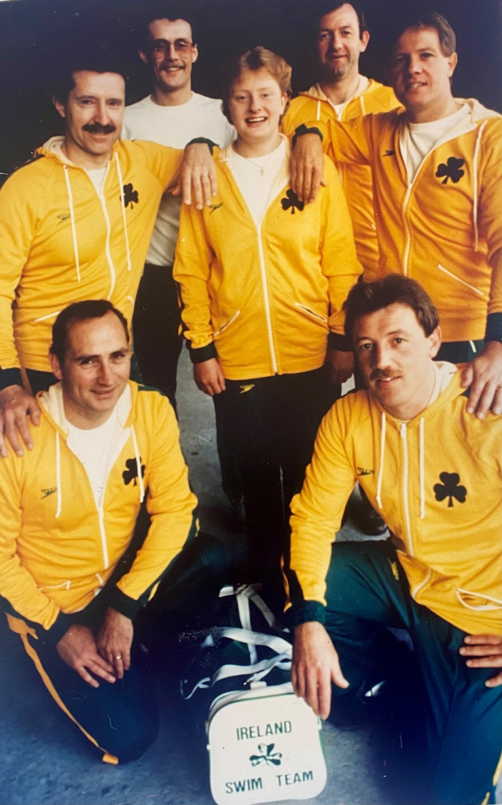
In 1986 I went to the first open water World Championships in Windermere. The American team had coaches, managers, and were staying in a five-star hotel. I was there with Mum and Dad staying at the camp site. Despite this for me it was a successful swim – I finished 9th. It taught me something early: drive can overcome disadvantage. But just as important is your tribe—the people backing you. After that swim, other competitors suggested I could swim the English Channel. Little did I know that would be the start of a 40-year journey.
The Irish Team at the 1986 Inaugural World Open Water Swimming Championships
Unfinished business
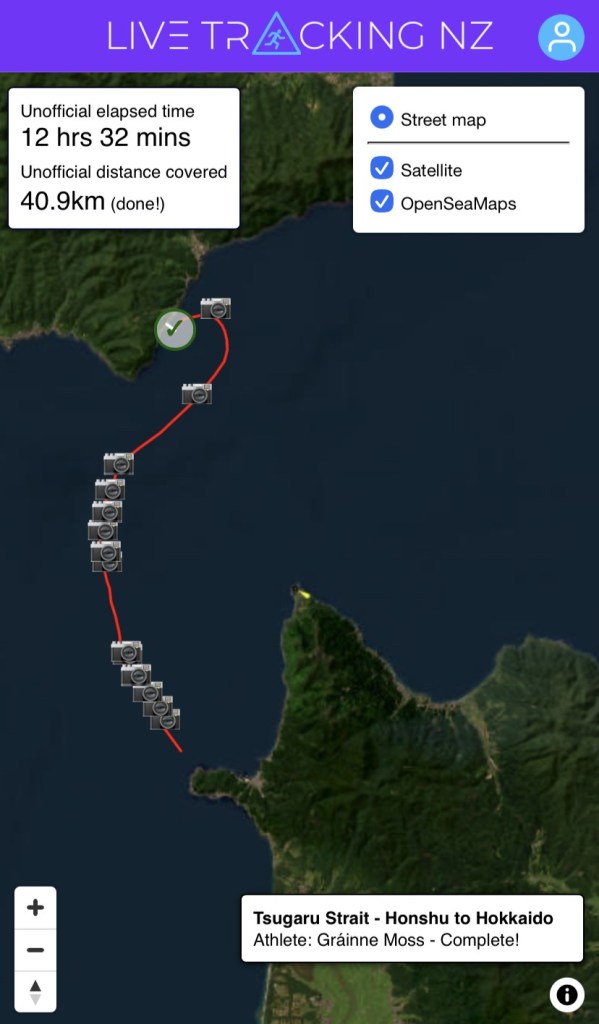
This was not my first go at Tsugaru. Last year, I swam 55 kilometres and didn’t make the other side. The current just said no. I got properly caught and couldn’t break free. It was one of those swims where the ocean reminds you very clearly that you’re not in charge. So coming back this year was always about unfinished business. Getting a slot isn’t straightforward, but I was lucky enough to get one—and took an early spot, just in case things didn’t go to plan.
Two weeks out
Training had gone well. I felt strong. And then, two weeks before travelling, I smashed my hand into a lane rope. It sounds small. It wasn’t. For ten days I could barely use it. The hardest part wasn’t the swimming—I couldn’t. It was everything else: getting dressed, carrying things, typing with one hand.
And the doubt started to set in. It was very hard to keep calm and not spiral into a negative place.
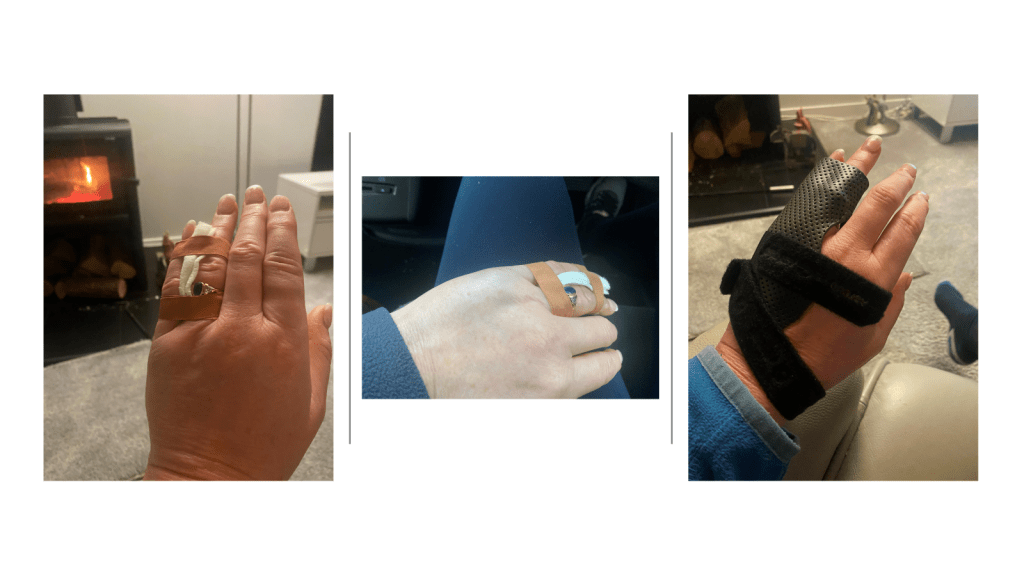
I remember sitting at the beach café the next weekend with the Washing Machines (the amazing Wellington swim group) and bursting into tears. Not from pain—just from the fear that something I’d worked towards for so long might slip away this late. The hand improved. Slowly. Not fully. The question was whether it would be enough. I arrived in Japan and tested it in the Olympic pool. It held up. Not perfect. But workable. Then we headed north to Aomori, and things became real.
The call
We met the pilot and the administration team on the 17th. They told us Friday the 19th was the only possible day of the 5 day window (18-22nd June). The forecast shifted—again and again. Good, bad, uncertain.
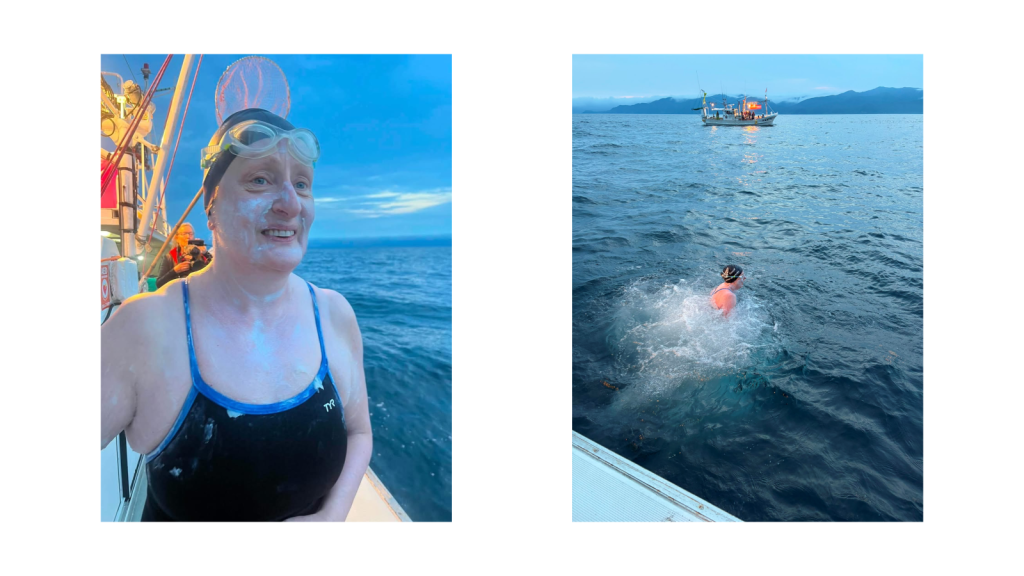
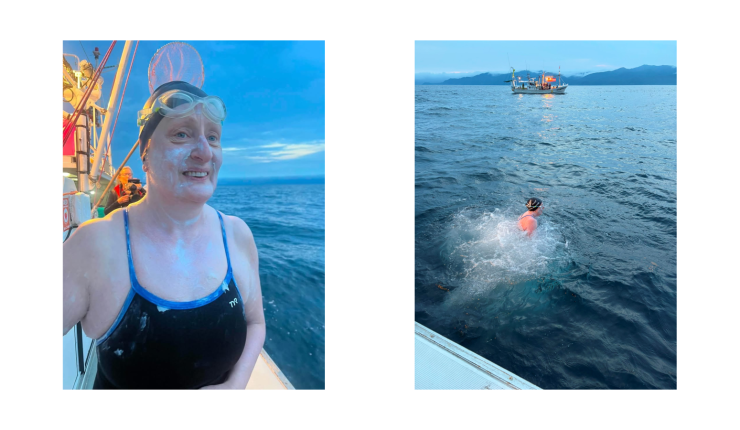
Just after 4pm on the 18th, the call came: the swim was on. We had to be at the dock at 03:10am, which meant getting up just after midnight. Food, feeds, sunscreen, quiet preparation. The drive out—remote, rural, very dark and still. The rules are strict. You cannot enter the water before sunrise. At 04:06, at the exact moment of sunrise, after the observers (who ensure you follow all the rules) gave me my first ever swim countdown, I jumped from the boat, swam to shore, raised my hand—and started.
The swim
Even when Tsugaru looks calm, it feels alive. The water is full of energy—movement under you all the time. It’s what makes it beautiful, and what makes it so hard. The first seven hours were good. I fed fast, determined not to let the currents take me backwards. At seven hours I saw land—the finish. For a moment, it felt within reach. One of those rare moments mid-swim where you let yourself think: this might actually go smoothly. (I should know better.)
Tsugaru had other ideas. The current built from 0.5 knots to 3.6 knots, enough to stop us getting to the coast. The team told me to swim hard. I did—grateful for every bit of speed work I’d done. On the boat the team were starting to get anxious. No-one wanted a repeat of last year. Around eight hours in, Ellen got in and swam beside me for an hour. Calm, steady, there when it mattered most. She also somehow produced a tracker from her bag when ours failed—one of those moments you’re very glad to have a swimmer and outdoor enthusiast on board.
Finding a way in
I rounded the headland, couldn’t land, tried along the coast—and was pushed back. The pilot decided to try a different approach, turning down the coastline, looking for a way through, trying to find a line that would actually let me in. At that point, it stopped being about distance. It became about finding a way to shore. Eventually, an opportunity opened. I went for it—through lines of buoys, over what were probably fishing pots, and up onto a rough, stony shoreline. Not a triumphant run up a beach. Just rocks—and an unsteady stand. I raised my hand. The swim was done. But Tsugaru wasn’t quite finished. Because the boat was 750 metres away, and I had to swim back to it. And I really really didn’t want to.
Warming up
Back on the boat, I was spent and I was cold—properly cold. The water temperature had dropped from 18 degrees at the start to 16 at the finish, but cold patches down to 14 and I felt it. I shivered for about an hour and a half—the shivering – honestly, almost as exhausting as the swim itself. My muscles were protesting loudly saying: we are sore, we have just swum a long way and now you are tensing and shaking us. Really?
The welcome
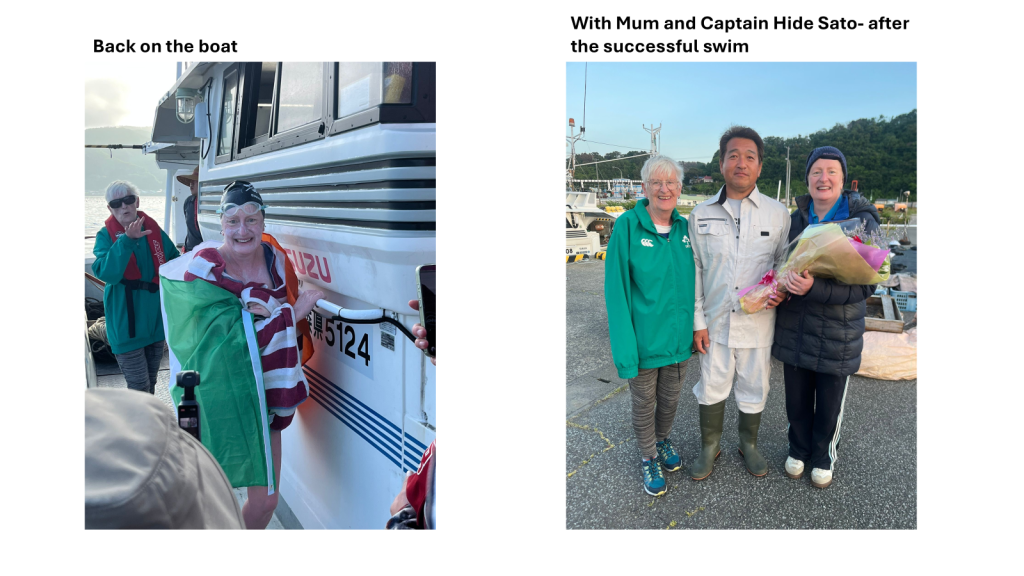
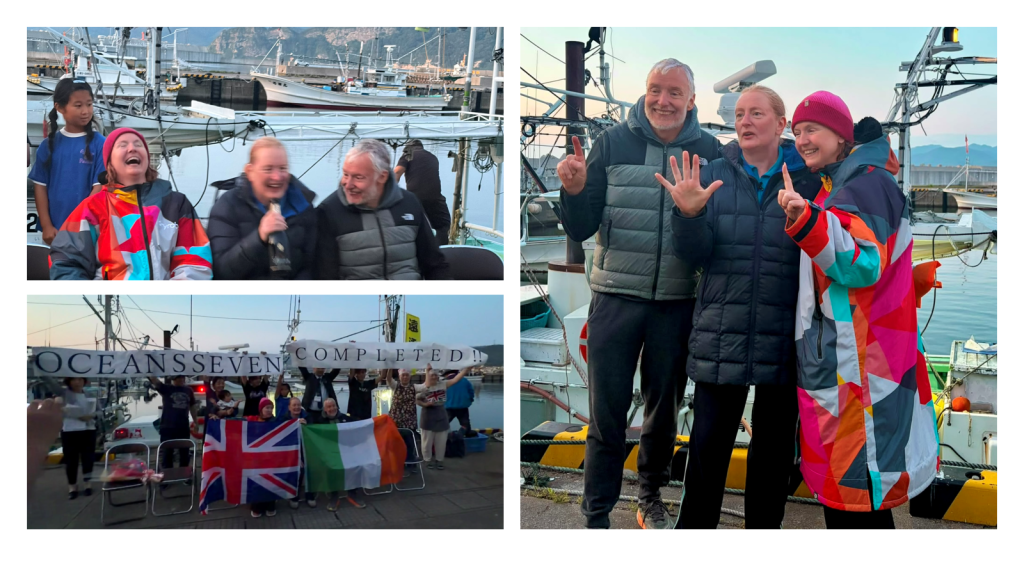
And then, arriving back into Kodamari port—it was extraordinary. A full welcome. Irish flags, banners, flowers, photos. Thoughtful, generous, and slightly surreal.Two other swimmers were in the water that day—Paul finished just before me, and Karen after. All three of us had tough swims. All three of us had been beaten by the tides last year, all three finished this year, and all three of us had now completed the Oceans Seven. There was something very special in that.
Paul came to my welcome, and then we went together to Karen’s. A shared understanding of what the day had taken.
Three Oceans Seven swimmers – Karen Ennis, Grainne Moss and Paul Leonard- completing it on the same day on the same swim- Amazing.
After that, we drove back. Like most post-swim nights, sleep didn’t come easily. Around 2am I gave up and went to find food. I was tired. Sunburnt. Sore.
The team
I couldn’t have done this without the people around me.
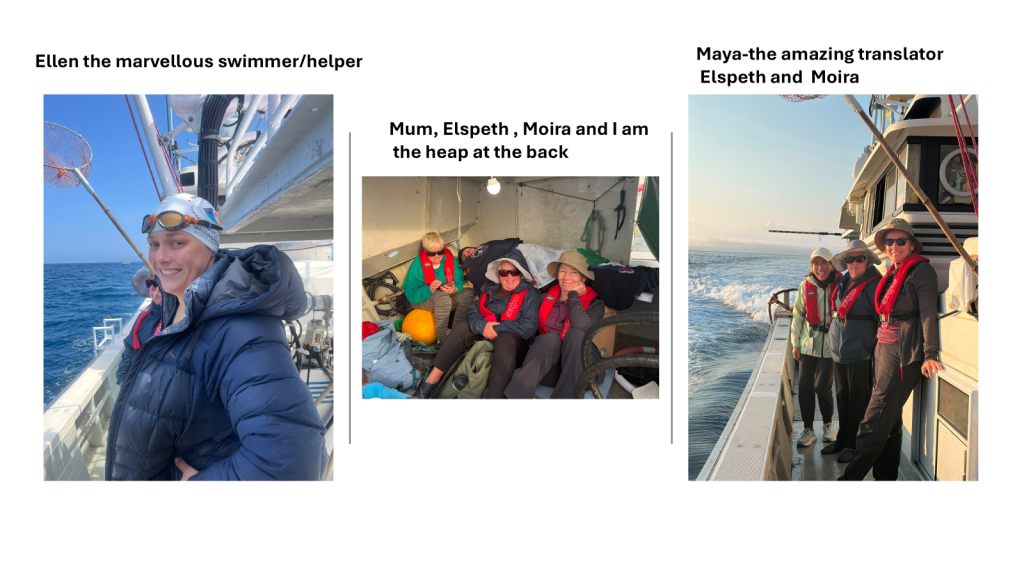
Ellen—support swimmer, doctor, and apparently carrier of spare trackers.
Maya—translator last year and this year, tech and social media wizard, now family
Mum—feeding me, cheering me on, and part of so many of these journeys.
Elspeth—bringing calm and making sure there was always enough food.
Tony and Dad—handling the driving, logistics, and everything in between.
I was incredibly well supported. And as always family and friends especially, Ivan, Orla, Leo and Anna—who live with the preparation, the uncertainty, and the slightly strange rhythms of these swims. They know what goes into them in a way that’s hard to explain. Thanks also to the team at Kenzie’s Gift – as ever all swims raise vital funds -to dontate click here Gráinne Moss – Return to Japan
We also had a crew with us—making a documentary about Irish female open water swimmers. Moira was directing, with Bez and Spider filming and on sound—capturing the lead-in, the waiting, and the swim itself. I’m not sure what it will become, but I’m grateful they were there to capture some of the story.
If there’s a thread through this swim, it’s this:
It wasn’t perfect. It definitely wasn’t straightforward.
I came back. I started not quite at 100%. I trusted what I had, not what I wished I had.
I learnt in 1986 that drive can overcome disadvantage. And it still does.
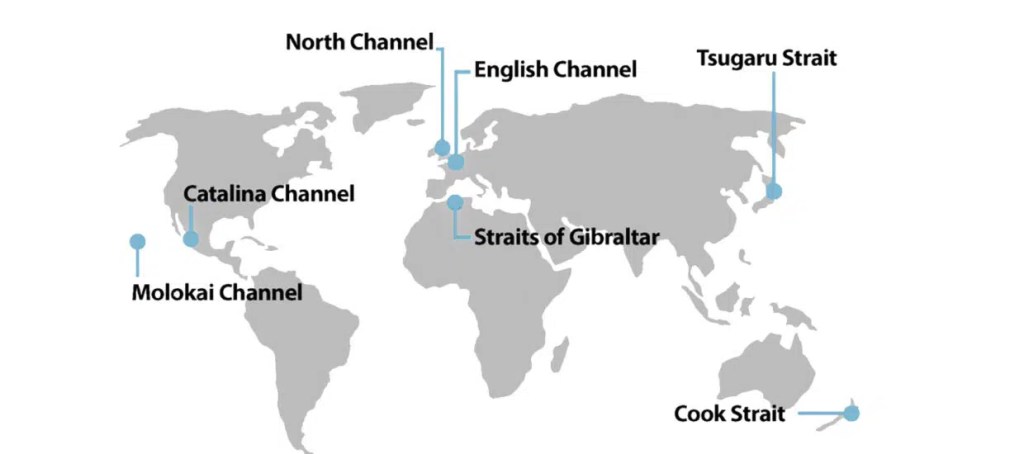
Oceans Seven
- English Channel – 3 August 1987 – 11 hours 52 minutes
- Cook Strait – 6 March 2001 – 12 hours 25 minutes
- North Channel – 22 July 2022 – 13 hours 33 minutes
- Kaiwi Channel – 12 May 2023 – 15 hours 7 minutes
- Catalina Channel – 7 July 2023 – 11 hours 22 minutes
- Straits of Gibraltar – 22 May 2024 – 4 hours and 23 minutes
- Tsugaru Strait – 19 June 2026 – 12 hours and 29 minutes
 IrishKiwiSwims
Brilliant write up and an amazing finish to the Oceans 7. An all round amazing lady who if I’m honest I was a bit in awe of. Now I know her to be a warm kind hearted absolute lady who is a fellow nutty swimmer 😊
LikeLike
legend!!! Totally inspirational.
I see the sea and the sea sees me!
LikeLike
We loved your story — what a story!!! with all the ups and downs, finishing with a happy ending, and such wise words about will power. I was watching your progress on Friday, sending prayers to accompany you on this your herculean challenge. Success, what a success. We send our congratulations. You have achieved at the highest level and shown the world that “drive CAN overcome disadvantage”
With our love, Sue and Godfrey
LikeLike
Fabulous read as always Grainne. Soooooooooooooo delighted for you. What an amazing achievement. BIG congratulations. So very proud of you. Love from us bothAuntie Margaret & Uncle Brian
LikeLike
Amazing. What grit and determination. Congratulations Grainne on your incredible achievement.
LikeLike